
Ready to start?
A 60-minute online appointment with Travis, private pay. You can decide after the first session whether to continue.
Book a Session with Travis →In short
couples therapy helps most when it changes what happens in those few seconds, so the same arguments stop running the relationship. You can do that work with me by secure video from anywhere in Florida or the other states where I'm licensed.
The pattern is the problem. The pattern can change.
Start with one 60-minute online session. You decide afterward whether to continue.
Book a Session with Travis →Why do the same arguments keep coming back?
The same arguments come back because the topic changes while the patterns underneath stay put. One month the conflict is about money. Next it's his children's holiday plans, or whether to sell the house in Palm Beach Gardens. The moves stay identical, down to who leaves the room first and who follows a few minutes later with one more point.
Couples therapists often call this a pursue-withdraw cycle. One partner reaches harder for a response as the other goes quiet to protect the peace, and each reaction feeds the other. Each response may be an attempt to cope, even as its impact hurts the other person. Together they become recurring conflicts that neither partner can see clearly from inside.
Most capable couples already know the communication tips, sometimes from earlier counseling. They have the skills on paper and still lose the thread when it counts. Under stress, the tips go offline, and old negative patterns take the wheel before anyone remembers a single I-statement.
Timing makes it harder. Research from The Gottman Institute suggests couples wait an average of six years of unhappiness before they seek counseling. Those years give resentment time to compound like interest. By then both partners can predict the other's next line, which is a strange kind of intimacy.
Who is couples therapy in Palm Beach County a good fit for?
Couples therapy is a good fit for couples who have tried the obvious fixes and watched the same conflict return anyway. Many are in midlife or later. Some are physicians with a practice in West Palm Beach or attorneys deep in trial prep. Others are a year past a business exit, or retired in Palm Beach Gardens and adjusting to a quieter life.
The relationship difficulties that bring couples to counseling here tend to cluster:
- Recurring patterns of conflict that end the same way whatever the topic.
- Emotional distance after decades of building careers and family life side by side.
- Affair recovery, when trust has broken and both partners want to know whether it can be rebuilt.
- Second marriages, often after a divorce, where loyalty to children from a first marriage strains the couple.
- Neurodiverse relationships, where ADHD, autism or rigid perfectionism shapes how each partner communicates.
Demanding schedules make relationship difficulties worse, because hard conversations keep waiting until after the board meeting and then until after the grandchildren leave. Seeking therapy can feel like admitting failure. Many partners end up describing therapy as personal growth instead.
What can one ordinary disagreement reveal?
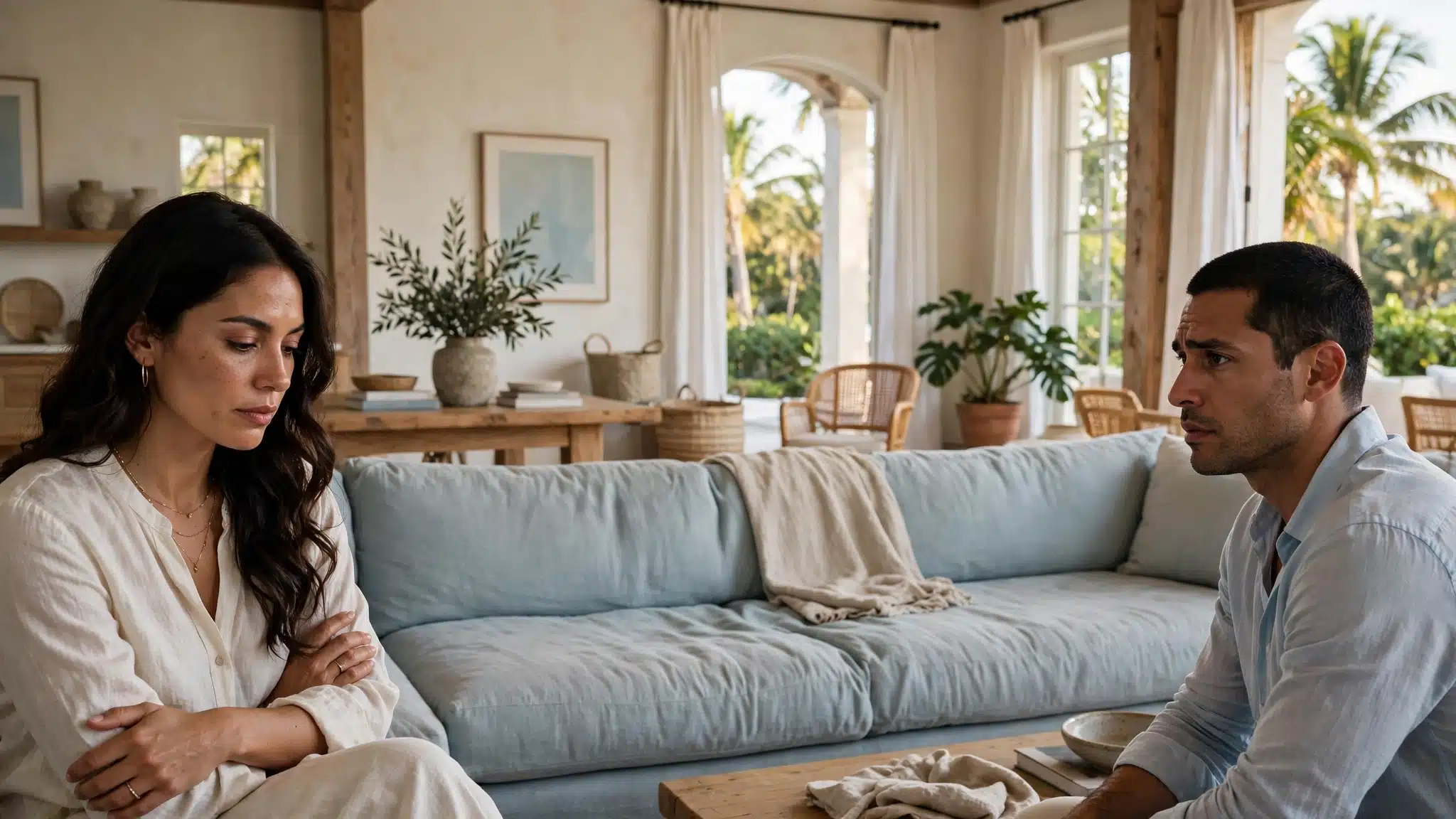
One ordinary disagreement can carry far more than either partner realizes. The following fictional example illustrates how the pattern can work.
Illustrative example
It is October in Palm Beach Gardens, and a storm cone has appeared on the forecast. Anna wants the hurricane shutters up today. Mark wants to wait until the track looks, in his words, committed. By dinner they are arguing about plywood, and neither can explain why a hardware question makes both of them so angry.
Underneath, two older patterns are running. Early in life, Anna became the one who handled every emergency, because no adult in her house would. Mark's family teased anyone who worried. Anna's preparation feels to Mark like criticism of his judgment, while his ease feels to her like being left alone with the responsibility again.
Both still need a storm plan. They also need to understand why discussing it leaves each of them feeling dismissed. Good couples counseling keeps those two conversations separate.
A different conversation might start with Anna saying that when he brushes this off, she feels alone with it. Mark takes in that fear without agreeing with every forecast, and they agree on when to act and how to share the work.
How does a Gottman Method couples therapist understand that moment?
My training gives us several ways into the same difficult moment. We can look at what happens between you, what each of you needs, and why one exchange carries so much weight. Three certifications bear directly on it:

Travis Atkinson, LCSW
- Certified Gottman Method Couples Therapist since 2006, one of the first in New York City, with eight years at The Gottman Institute.
- Certified Emotionally Focused Couples Therapist and Supervisor, trained directly by Dr. Sue Johnson.
- Certified Schema Therapy for Couples Therapist, Supervisor and Trainer, a model I co-developed with Dr. Jeffrey Young.
The Gottman Method looks at what happens between you. It grew out of decades of research on how couples build friendship and manage conflict, and it gives you a shared map of the relationship. Gottman training runs three levels, then a certification track of up to two years with a consultant reviewing recorded sessions.

Emotionally Focused Therapy for Couples, or EFT, looks at what each of you needs underneath the fight. Its aim is a secure emotional bond, the felt sense that your partner will show up when it counts.
Schema therapy looks at where the patterns came from. A schema is a long-standing emotional theme from early life, and marriage can set it off with startling force. With imagery rescripting, for example, we revisit an old memory to work with its emotional meaning and the needs that went unmet. What happened doesn't change. How much power it holds over the present often does.
Some therapists stick to one model. In my clinical work, I combine these evidence-based approaches into one therapeutic approach. Together they give couples comprehensive support through the therapeutic process, and they let me follow what is happening in the relationship rather than a script. Clients rarely notice the seams.
What happens in a session, and how does cognitive behavioral therapy fit?
When the pattern appears in a therapy session, we work with it as it happens. I might pause an exchange and ask what you heard your partner say, and what you felt you had to protect in the relationship at that moment. Then I help you try the conversation again, with room for both the hurt and the response. After that, you practice it together, with me guiding.
Cognitive behavioral therapy adds a practical layer, helping partners catch distorted thinking, such as "He's late because he doesn't care," and test it against the evidence. Solution-focused brief therapy adds tools for building on what already works.
What happens in the initial session and the assessment?
The first counseling session runs 60 minutes online and works as an intake assessment, with the same session length as the rest. I hear what brought each of you here, what you have already tried, and what you hope could change.
The hour gives you a chance to begin understanding the pattern in your relationship and to see how I work as a therapist with two people at once. It also shows whether we're a good fit. You decide afterward.
If we continue, the assessment includes an individual session with each partner. These individual assessment appointments allow a deeper exploration of life history, individual goals and of things someone may not say with a spouse listening. Then we meet together for feedback before treatment starts. I look for patterns in the relationship more than the story, and you hear how I understand your cycle and the strengths I see in it.
Together, we build a treatment plan. Collaborative goal setting happens early, because both of you have to want roughly the same destination for the relationship and your life together. Every treatment plan is personalized care, and booking the first session does not commit you to the rest. Treatment adapts as your therapy progresses.
After you book, you'll receive a confirmation with a secure video link. Each partner completes intake forms online before the first counseling session.
Begin with one session
Each partner completes intake forms online, and you receive a secure video link after booking.
Book a Session with Travis →Get My Scheduling Link →What do couples work on, and what happens between sessions?
Most couples start therapy with two skills. One is raising a hard topic without setting off a defense. The other is repair, getting back on track after a conflict instead of letting it simmer for days, or through a dinner party.
Other common goals include:
- Communication breakdowns, where every conflict turns into a cross-examination.
- Emotional regulation, staying calm enough to hear each other when the stakes feel high.
- Trust in the relationship, rebuilt after secrecy or a broken promise.
- Connection, finding the friendship again after years of logistics.
In therapy sessions I teach active listening, the kind where you check what you heard before you answer, along with emotional regulation. We look at communication styles, too, because a partner who thinks out loud and one who thinks in silence will misread each other on schedule.
Between therapy sessions you practice the skills. It might be a short evening check-in or an agreed signal for catching the loop as it starts. New skills stick through repetition at home. Online therapy makes room for the work inside a demanding life, and what you practice between appointments matters as much as the hour itself.
Over time, couples develop healthier ways of handling pressure in life they can't avoid. Many partners describe the positive changes as personal growth as much as relationship repair.

How long does couples therapy take, and how long is each session?
Marriage therapy sessions run 60 minutes, weekly at first. Couples sessions across practices commonly run 50 to 80 minutes. The American Association for Marriage and Family Therapy reports that couples therapy averages about 11.5 sessions. In practice, that often means somewhere around 8 to 12 sessions over three to six months, though some couples need longer. Your own timeline depends on what brings you in and how the work progresses in daily life. I review progress with you as your therapist and adjust the plan as needed. As positive changes take hold, we may space appointments farther apart and focus on sustainable change.
Is online couples therapy as effective as in-person counseling?
Research on video couples therapy is encouraging, with limits. A 2022 randomized trial in Frontiers in Psychology compared 30 couples in a structured relationship program delivered by videoconference or face to face. Relationship satisfaction and mental health outcomes were similar in both groups.
That small study supports video delivery for many couples. It doesn't prove equivalence for every couple or every approach, and I'd rather tell you that than oversell it.
I offer counseling online for all regular sessions, and in-person sessions happen only within a specially arranged intensive. Many practices offer both formats. Couples join from home in Palm Beach, FL, from an office in West Palm Beach, or from two different cities during a busy week.
Plenty of couples put off seeking therapy because they don't want a familiar car spotted outside a therapist's office in West Palm Beach. Online therapy removes that problem. There's no waiting room and no neighbor in the next chair.
In online therapy, licensing follows the client. Each partner must be physically located in a state where I'm licensed during sessions, which means Florida, New York, Connecticut or Vermont. For couples who live part of the year up north, counseling continues when you go.
Can couples therapy help after an affair, or when one of you is unsure about staying?
Yes, though the help looks different depending on where you are. Some couples arrive already talking about divorce. Affair recovery counseling follows a structure, and we stabilize the crisis first. Then we build an understanding of how the affair happened, without excusing it, and rebuild trust and a relationship you can both live in.

Uncertainty and a settled decision are different. If one of you is unsure whether to stay, couples therapy can help you decide with clarity. Some couples in that spot benefit from discernment counseling, a short, structured process for deciding whether to repair the relationship or end it.
If one partner has already decided to leave, couples therapy usually isn't the right fit. Divorce decided calmly tends to go better for everyone, including the kids, and I can point you toward the right support.
Safety comes before any of this. When there is violence, intimidation or fear at home, safety assessment and specialized treatment take priority, and joint sessions may not be suitable.
Clarity starts with one conversation.
Whether you are rebuilding or deciding, the first session gives you a map of where you stand.
Book a Session with Travis →Can one partner start with individual therapy or individual counseling?
Yes. One partner can begin therapy alone, and individual therapy focused on the relationship can still shift daily life at home. In practice, both partners usually come, even when one arrives with arms folded.
A hesitant partner often worries that marriage counseling will turn into a trial with the therapist as judge. Neutrality in couples counseling, as I practice it, means I work to understand both of you while addressing harmful behavior directly. Both of you need to feel safe and heard.
Individual counseling with me as your therapist is also available when the goal is your own patterns in relationships rather than joint work.
How does couples therapy help blended families, and when is family therapy with a family therapist better?
Couples therapy helps blended families by strengthening the relationship at the center, so the rest of the family has something steady to lean on. A second marriage after a divorce brings his children, her children and two sets of family rules into one life. The estate plan, the family holidays and the grandchildren's visits can become stand-ins for older questions of loyalty. Nobody says that out loud.
Family dynamics from your own childhood show up too. Schema therapy helps here, because it explains why one comment at Thanksgiving can land with the weight of thirty years. Understanding those patterns can help partners respond with less blame.
The focus of couples counseling stays on the two of you, even when family is the topic. Couples therapy is different from family therapy, which brings children, stepchildren or extended family into the room together for sessions. If family therapy or family counseling would help your children, I can refer you to a family therapist who fits.
How do intimacy concerns and sexual issues fit into couples counseling?
Intimacy concerns rarely sit apart from the rest of the relationship. Desire follows distance. When conflict becomes the background noise of family life, touch can feel like a risk instead of a comfort.
In marriage counseling we talk about sexual issues directly, usually after some emotional safety has returned. That order matters. Effective couples therapy can improve communication, empathy, intimacy and overall relationship satisfaction, and couples often notice the last two arrive together. When a couple needs a sex therapist alongside our work, I coordinate with one.
What do Palm Beach couples ask before booking?
Does insurance cover couples therapy?
Most insurance plans do not cover couples therapy. When they do, it is usually billed as family therapy under CPT code 90847, tied to a mental health diagnosis for one partner. That code covers conjoint family psychotherapy.
My practice is private pay. If you request out-of-network reimbursement yourself, your insurer will receive treatment information, including a diagnosis. Private pay also leaves treatment decisions between you and your therapist. Before we begin, you'll receive a Good Faith Estimate, which the federal No Surprises Act requires for self-pay clients.
Is there a complimentary phone consultation before booking?
Not as a free consultation, but you can complete the short form to receive a scheduling link for a brief conversation with me. That conversation can help gauge whether we're a good fit before regular therapy sessions begin. If you are ready, you can book your first session directly.
Do you offer in-person couples counseling in Palm Beach?
Regular marriage counseling sessions are exclusively online, which many couples in Palm Beach and West Palm Beach prefer for privacy and scheduling. In-person work may be available as part of a specially arranged intensive. Contact me to discuss availability.
Do you work with couples in West Palm Beach and Palm Beach Gardens?
Yes. I work with couples across Palm Beach County, including West Palm Beach, Palm Beach Gardens, Jupiter, Delray Beach and Boca Raton. Couples on the island in Palm Beach, FL, get the same work as couples farther inland. Marriage counseling online works the same from West Palm Beach as from Jupiter.
Do you offer intensive couples therapy?
Intensive couples therapy may be available by special arrangement, including in person. Contact me to discuss whether it fits your situation.
How do you choose the right therapist for couples work?
Whether you call it marriage counseling, marriage therapy or couples therapy, training matters more than the title. Many mental health professionals offer counseling to couples as one service among dozens, and some therapists train mainly in family therapy. A licensed marriage and family therapist can provide couples counseling, and so can licensed psychologists, mental health counselors and clinical social workers. Your therapist needn't be in West Palm Beach. Ask whether they are certified in a structured couples model and how much of their practice is couples counseling.
What if ADHD, autism or perfectionism shapes our relationship?
Neurodiverse relationships need a therapist who understands how differently two minds work. ADHD is the classic case. When it is a big factor, I adapt the treatment to how each brain processes, which might mean shorter practice loops, written summaries or explicit agreements in place of hints. Rigid perfectionism can strain a marriage too, and when it is pervasive and lifelong, a careful assessment sometimes points to OCPD.
Can we keep working when we go north for the summer?
Yes. Counseling continues as long as each partner is in Florida, New York, Connecticut or Vermont during sessions, even if one of you stays in Florida.
Ready to start?
You know the conversation you keep having. The first session gives us somewhere to begin.
Bring what keeps happening between you, even if you disagree about why. I'll help you begin to understand where the exchange gets stuck and what we can work on together.
Start with one session
Not ready to book? Complete the short form to receive a scheduling link for a brief conversation with Travis.
Book a Session with Travis →Get My Scheduling Link →Online couples therapy in Florida, New York, Connecticut and Vermont. Each partner must be physically located in one of these states during sessions. In-person appointments may be available for specially arranged intensives.
About the author: Travis Atkinson, LCSW, is the founder of South Florida Marriage Therapy, an online practice based in Fort Lauderdale serving couples across South Florida. His clinical work brings Gottman, EFT and attachment, schema therapy and experiential methods together as one integrated approach. He has been a Certified Gottman Method Couples Therapist since 2006 and spent eight years at The Gottman Institute. As a Certified Emotionally Focused Couples Therapist and Supervisor, he co-created with Dr. Sue Johnson the first EFT training video for gay and lesbian couples. His training with Dr. Jeffrey Young began in 1994, and together they developed Schema Therapy for Couples. He is one of the original founders of the International Society of Schema Therapy, which honored him with Honorary Lifetime Membership in 2020, and directs the ISST-approved Schema Therapy Training Center of New York. Travis holds a graduate degree in clinical social work from NYU and is licensed in Florida, New York, Connecticut and Vermont.
A 60-minute online appointment, private pay. You decide after the first session whether to continue.